
Europe's 60 Billion Cubic Meter Problem: The Gas Crisis Nobody Is Preparing For
EU storage is at its lowest post-winter level in five years. Ras Laffan is gone for half a decade. And Europe needs the biggest refill in its history by November. The math does not work.

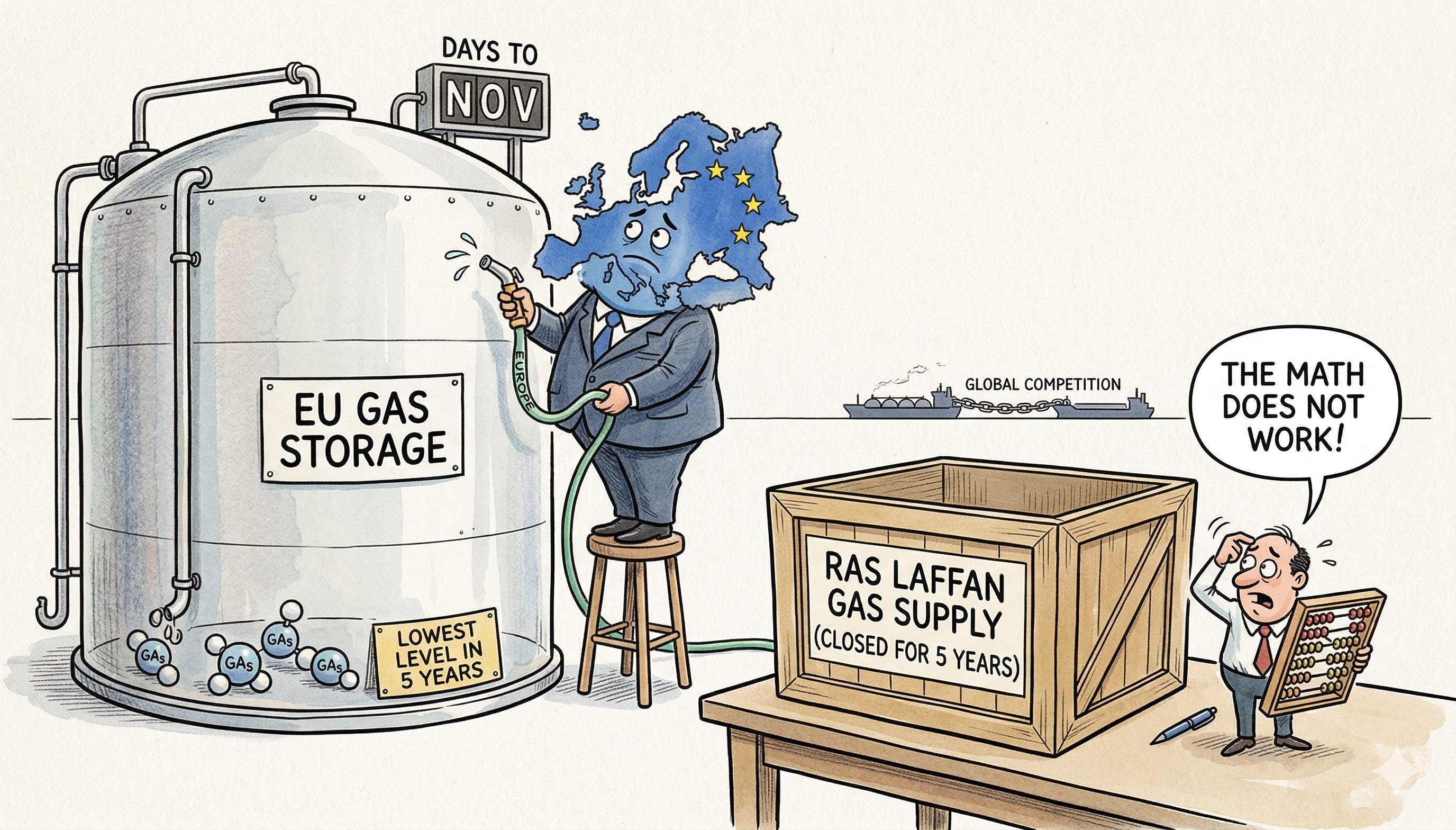
Forget Brent for a moment. The oil price will dominate every headline between now and whenever this war ends. But the crisis that will actually reshape European economies for the next three to five years is happening in a market that most people outside the energy industry barely follow: natural gas.
On March 22, EU gas storage stood at approximately 34% of capacity. Germany — the continent’s largest economy and biggest gas consumer — was at 30.2%. France at 29%. The Netherlands, home to the TTF benchmark that prices most of Europe’s gas, at 23.5%. These are the lowest end-of-winter levels since the 2022 Russian gas crisis. In some countries, they are worse.
EU regulation is clear: storage must reach 90% of capacity by November 1. That is not a guideline. It is a legal requirement, codified after the 2022 crisis to prevent a repeat of the scramble that nearly shut down German industry.
The arithmetic from 34% to 90% requires injecting roughly 55-60 billion cubic meters of gas between Apr…
